
SoftWave Therapy for Back Pain Relief in Los Angeles
Does SoftWave therapy help back pain?
SoftWave therapy is a non-invasive acoustic-wave treatment. Research on shockwave therapy for back pain focuses on chronic low back pain without a specific structural cause, where trials have reported short-term pain relief and improved function. Evidence for sciatica and disc problems is limited, and the pain relief seen in trials has been short-term.
Where Does Your Back Pain Go?
The path your pain takes helps point to its cause and the right first step.
Stays in the low back
An ache or tightness that changes with movement, sitting, or bending.
May point to: muscle or soft-tissue strain, or spinal arthritis. This is the most common pattern and the one shockwave research has studied most.
Spreads into the buttock or hip
Pain low on one side, sometimes worse when standing on one leg.
May point to: sacroiliac joint pain or a hip problem.
Travels below the knee, or into both legs when walking
Shooting or burning pain down the leg, sometimes with tingling. Or heaviness in both legs when walking that eases when you sit or bend forward.
May point to: a nerve, such as sciatica, or spinal stenosis. A physician needs to confirm the cause first.
Go to an emergency room now
For new loss of bladder or bowel control, numbness in the groin or saddle area, or leg weakness that is getting worse quickly.
See a physician promptly if back pain comes with fever, unexplained weight loss, a history of cancer, or follows a fall, car accident, or other significant injury. SoftWave is not appropriate until these have been evaluated.
Back Pain and SoftWave Therapy: Key Facts
people had low back pain worldwide in 2020, the leading cause of disability, according to the World Health Organization.
of low back pain is non-specific, meaning no single structural cause can be identified.
- A 2021 meta-analysis of 10 trials and 455 people found shockwave therapy reduced chronic low back pain at one month, but not at three months.
- The same 2021 meta-analysis found shockwave therapy improved disability scores at both one and three months.
- A 2020 sham-controlled trial of 40 people found radial shockwave plus core exercise reduced pain more than core exercise alone.
- Shockwave research on back pain centers on chronic non-specific low back pain, not sciatica or disc herniation.
- The OrthoGold 100's FDA clearance covers the device, not back pain specifically.
- SoftWave therapy is generally not covered by insurance.
In a Client's Words
I can already feel less restriction on my lower back. The biggest thing I'm noticing is the tension... I can bend over without fear.”
SoftWave Vitality client, describing how their back felt after a treatment session
Individual results vary. One session's experience does not predict the result of a full treatment series.
Common Causes of Back Pain
The colored tag on each cause matches the pain paths above.
Muscle and soft-tissue strain
The most common source of low back pain. Strain-related back pain often follows lifting, a sudden movement, or long hours of sitting, and usually has no single cause visible on imaging.
Spinal arthritis
Wear in the small facet joints that connect the vertebrae. Spinal arthritis typically causes stiffness that is worst in the morning and eases with gentle movement.
Sacroiliac joint pain
Sits low on one side, near the dimples at the base of the spine, and can spread into the buttock or hip. See SoftWave Therapy for Hip Pain.
Disc problems
Include disc degeneration and herniation. A herniated disc can press on a nerve root and send pain down the leg.
Sciatica
Irritation of the sciatic nerve. Sciatica pain usually travels below the knee and can come with numbness or tingling in the leg or foot.
Spinal stenosis
Narrowing around the nerves in the spine. Spinal stenosis commonly causes leg pain or heaviness when walking that eases when you sit or bend forward.
Is SoftWave Right for Your Back Pain?
Shockwave research on back pain is uneven across conditions:
Chronic non-specific low back pain, the muscle and soft-tissue pain that makes up most cases.
Sacroiliac joint pain and spinal arthritis.
Sciatica, disc herniation, and spinal stenosis.
Back pain with nerve symptoms such as leg weakness or numbness should be evaluated by a physician before SoftWave is considered. The consultation screens for those signs first, then decides with you whether SoftWave makes sense or a referral comes first.
What Does the Research Say?
The pooled evidence
A 2021 systematic review and meta-analysis in BioMed Research International (Yue et al.) combined 10 randomized controlled trials with 455 people who had chronic low back pain. Compared with sham or other treatments, shockwave therapy lowered pain scores at one month, but the difference was gone by three months. Disability scores improved at both one and three months. Read the review
Shockwave compared with sham or other treatments, Yue et al. 2021.
A sham-controlled trial
A 2020 randomized trial in the Journal of Clinical Medicine (Walewicz et al.) assigned 40 people with chronic low back pain to radial shockwave or sham shockwave, with both groups doing core stability exercises. The shockwave group had greater pain relief, especially at follow-up, and better postural control. Study record
Where the evidence is thin
The pain benefit in the pooled studies faded by three months. Trials were small, used different devices and protocols, and mostly studied non-specific back pain rather than sciatica or disc problems. None used SoftWave's broad-focused device.
The takeaway: research on shockwave therapy suggests possible short-term improvement in pain and function for chronic low back pain. Pooled studies found disability scores improved at three months, but study quality and treatment protocols varied. The findings do not establish long-term effectiveness, and they do not show the same results with SoftWave's specific device.
SoftWave Therapy vs. Other Back Pain Treatments
| Treatment | Primary purpose | Evidence and considerations | Recovery or follow-up |
|---|---|---|---|
| Heat, ice, and over-the-counter pain relievers | Ease pain during a flare | Helpful short-term; long-term pain reliever use carries side-effect risks | As needed |
| Exercise and physical therapy | Build strength, mobility, and confidence moving | The foundation of care in clinical guidelines for chronic low back pain | Ongoing program |
| Spinal manipulation, massage, or acupuncture | Hands-on or needle-based symptom relief | Listed as options in some guidelines for chronic low back pain; effects are usually modest | Series of visits |
| Shockwave therapy (including SoftWave) | Non-invasive acoustic-wave treatment | Trials of shockwave in general show short-term pain relief and improved function in chronic non-specific back pain; not specific to SoftWave's device; limited evidence for sciatica | Weekly sessions; studied alongside exercise, not instead of it |
| Epidural steroid injections | Calm an irritated nerve root | Mainly used for sciatica; relief is often short-term | Repeat only as advised |
| Spine surgery | Relieve specific structural problems, such as nerve compression | Effective for selected structural causes; not used for most non-specific back pain | Surgery followed by rehabilitation |
Exercise and movement-based care remain central to managing chronic low back pain. Shockwave therapy is an additional option still under investigation, not a replacement for established care. Your plan depends on what is causing your pain, what you have already tried, and your goals.
How SoftWave Therapy Works on the Back
SoftWave Vitality treats back pain with the OrthoGold 100, an electrohydraulic acoustic-wave device with a broad-focused design. The OrthoGold 100's FDA 510(k) clearance applies to the device and its cleared indications. The OrthoGold 100 is not FDA-cleared specifically to treat back pain.
Read more about SoftWave therapy in Los Angeles, including the technology and what a full treatment series involves.
Low back pain often involves a wide band of muscle and connective tissue rather than one small spot. Broad-focused energy covers a wider area per pass than focused devices.
Shockwave therapy is thought to act through mechanotransduction, turning mechanical energy into cellular signals. Laboratory research links those signals to increased local blood flow, lower inflammatory markers, and tissue-repair activity.
Back pain trials measure pain scores, disability scores, and movement. These trials do not show that shockwave repairs discs or reverses spinal arthritis.
What to Expect: Your Treatment Roadmap
- 1
Consultation and history
Your practitioner asks where the pain sits, whether it travels, what makes it better or worse, and screens for the warning signs listed above.
- 2
Examination and mapping
Your practitioner checks how you move and uses the device at low intensity to find tender areas in the muscles along the spine and pelvis. Mapping guides treatment and does not diagnose the cause of your pain.
- 3
Treatment session
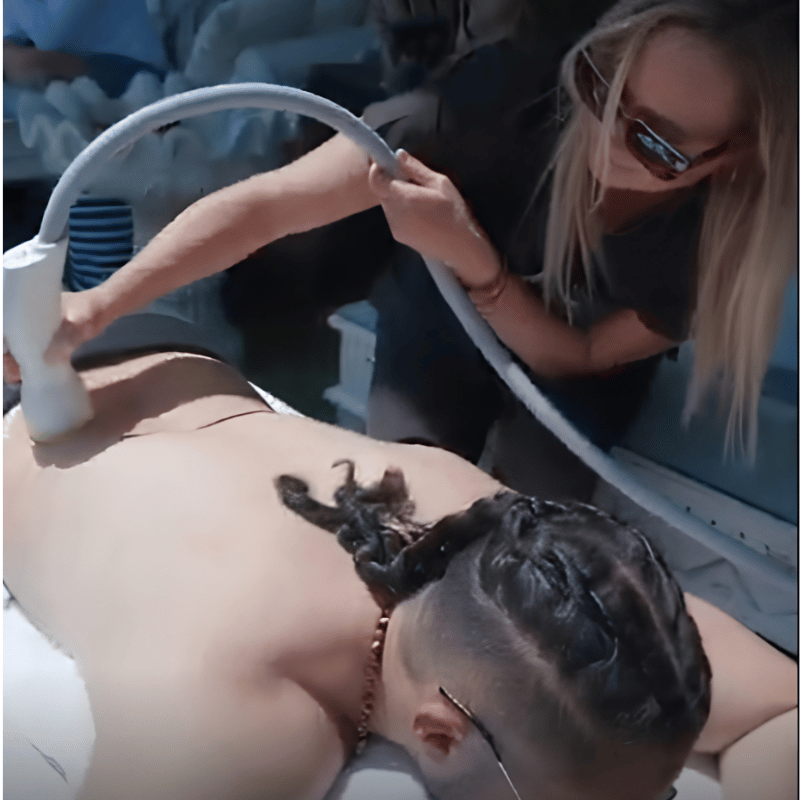
A back session is usually done lying face down. No anesthesia is used.
- 4
What it feels like
Clients describe a firm, rhythmic tapping. Tight or tender muscles can feel sore during treatment, and the intensity is adjusted to you.
- 5
Frequency and activity
Sessions are usually weekly. Staying active between sessions matters, and your practitioner may point you to exercise or physical therapy as part of your plan.
- 6
Progress review
Your practitioner reviews pain, movement, and daily function, then recommends continuing, tapering, referring you elsewhere, or stopping. Responses vary from client to client.
Not sure if SoftWave fits your back pain? Start with a $59 consultation and first treatment.
Cost & Investment
New clients start with a consultation, mapping session, and first treatment for $59. SoftWave is generally not covered by insurance, so your consultation includes a treatment plan and price before you commit to a series.
Visit SoftWave Vitality in Los Angeles
- Address
- 2154 Westwood Blvd, Suite 200, Los Angeles, CA 90025
- Serving
- Westwood, Brentwood, Santa Monica, Beverly Hills, Century City, Culver City, and West LA
- Phone
- (323) 422-1327
- Book online
- Book your $59 visit
Why SoftWave Vitality for Back Pain
SoftWave Vitality treats back pain as part of a practice devoted to one therapy. Read founder Bill Weatherford's story on the About Bill page.
Frequently Asked Questions
Can SoftWave help sciatica?
Shockwave research on back pain has mostly studied pain without nerve involvement. Evidence for sciatica is limited, so sciatica is assessed individually, and leg weakness or numbness is evaluated by a physician first.
When is back pain an emergency?
Back pain with loss of bladder or bowel control, numbness in the groin or inner thighs, or worsening leg weakness needs emergency care. Back pain after significant trauma, or with fever, also needs prompt medical evaluation.
How can I tell if my back pain is muscular or from a disc or nerve?
Muscular back pain usually stays in the back and changes with movement. Pain that travels below the knee, or comes with numbness or tingling, suggests a nerve is involved, often from a disc.
Is SoftWave appropriate after back surgery or a spinal fusion?
After spine surgery, your practitioner reviews the procedure, any hardware, and your surgeon's guidance before recommending treatment. Some post-surgical clients are referred back to their surgeon first.
How many SoftWave sessions does back pain usually take?
Back pain is typically treated over a series of weekly sessions. Your practitioner suggests a number after your consultation and adjusts it based on your progress.
What does SoftWave feel like on the lower back?
Most clients feel a firm, rhythmic tapping. Tight muscles along the spine can feel sore during treatment, and intensity is adjusted to your comfort.
Is SoftWave covered by insurance for back pain?
SoftWave is usually an out-of-pocket treatment for back pain. Your consultation includes a written plan and price before you decide on a series.
What if SoftWave doesn't relieve my back pain?
Results vary, and some clients do not respond. Your practitioner tracks your progress and discusses other approaches, including referral to a physician or physical therapist, if SoftWave is not helping.
Related Treatments
Low back pain often spreads into the hips, and active people often deal with both.
Ready for Back Pain Relief?
Schedule your consultation, mapping session, and first SoftWave treatment for $59.
Individual results vary. This page is for educational purposes and does not constitute medical advice. Consult with our team to determine if SoftWave therapy is appropriate for your specific condition.